REVIEW: Is the Cocktail Hour necessary?
Review





You go to the theater in Minnesota in December and you’re going to get some coughing. And some sneezing. And some incessant, maddening throat-clearing. But part of the magic of theater is that, for me at least, if the show’s compelling enough, all of that tends to fade into the background and become far less irksome. When the coughs start taking center stage, though, you know there’s something wrong.
Bodily emissions weren’t an issue for the first half of The Cocktail Hour, A.R. Gurney’s semi-dark comedy focused on a hard-drinking family of WASPs waiting for their dinner. It’s a play about well-heeled, profoundly white people working through personal demons, familial tensions and liberal guilt. It’s also a play about writing a play, with a script filled with meta-commentary and T.S. Eliot allusions that quietly congratulates its viewers for knowing a thing or two about theater. As it turns out, the folks who come out to a Tuesday night show at The Guthrie are precisely the audience for all of this.
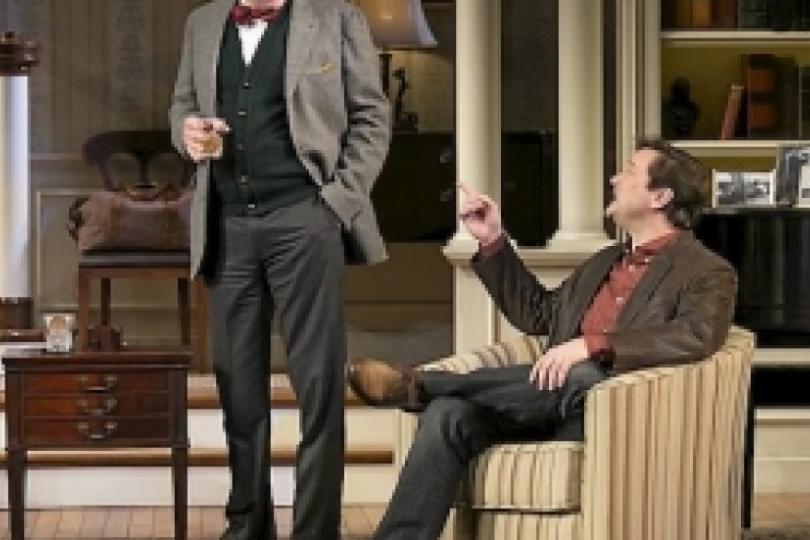
That isn’t to say the show doesn’t merit their attention. For its first half, The Cocktail Hour crackles along on the strength of its genuinely funny dialogue and lively performances from all four actors. For a play set entirely in a living room, it never hurts for kinetic energy, as director Maria Aitken keeps her cast constantly circling each other - both physically and metaphorically - and springing up to pour another drink any time the talk gets tense. As much as meta-fictional flourishes tend to grate on me, many of Gurney’s points about playwriting hit home, particularly the bits about the family’s more middlebrow members rejecting modern theater as a cesspool of vulgarity, plotlessness and excessive yelling.
And then the second act began, and I suddenly became acutely aware of the coughing and sniffling and clearing of throats. It was a cacophony sounding from all corners of the Proscenium, one cough answering another like a call-and-response song, and not a rumble was escaping my notice. It wasn’t that anything had changed on stage. Quite to the contrary, everything was more or less the same as it had been in the first act, and therein lay the problem. Around this point The Cocktail Hour began to feel unshakably familiar, from the rhythm of the conversations to the wealthy white people grasping at relevancy to the sitcom-staple brightly lit sofa at the foot of a wallpapered staircase.