A conversation with Scenic Designer Kejia Yu






Photo credits: Tom Taintor and Aaron Mark
Recently, I was able to connect with Set Designer Kejia Yu to get her insights on her most recent work How to Catch Creation which recently wrapped up production at The Theatre in the Round.
MW: What was the initial visual idea for this set?
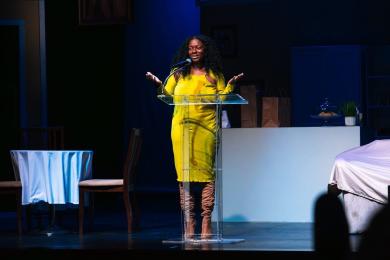
KY: The production takes place in a round theatre arena, and the story weaves through three couples from different generations, all connected by an ongoing conversation about creation. The initial visual idea focused on how to design a single apartment within a limited, shared space, one that could flexibly belong to all three couples, while allowing their stories to coexist without feeling separate.
MW: Where did you draw inspiration from for the design?
KY: The play engages with themes of race, identity, and the meaning of creation. My inspiration came from thinking about how these profound topics can live quietly within an everyday interior. Rather than making them overt or symbolic, I was interested in how creation exists in small, scattered moments, hidden within daily life, objects, and routines, much like the conversations unfolding in the play.
MW: Were there any references or artworks that guided the look and feel?
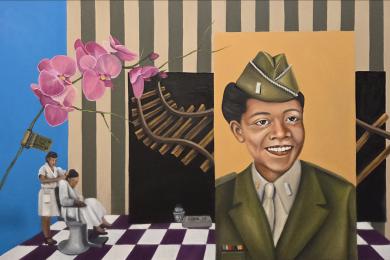
KY: I had many conversations with the director, Vanessa Agnes, around themes of Black feminism and related artworks. Those discussions directly influenced the visual world of the production. We placed paintings referencing these ideas along the aisles surrounding the arena, allowing the audience to encounter them as part of the space. In the set dressing, we also made intentional choices to include objects and decorative elements that aligned with and supported those themes in a more subtle, lived-in way.
MW: What emotion or story were you hoping the set would communicate?
KY: More than anything, I wanted the set to communicate warmth, hope, and the vitality of creation. One of the central elements was a crystal installation that extended from upstage into the center of the arena. We spent a long time building it piece by piece, allowing the process of handwork itself to quietly represent creation.
We integrated light bulbs of different shapes into the installation and collaborated closely with lighting designer Mark Kieffer to suspend them within the structure. The result was a constellation of small, glowing points, something that functioned naturally as a chandelier within the apartment, while also serving as a symbolic representation of creation as we understood it: fragile, luminous, and alive.
MW: How early were you involved in the production process?
KY: As the set designer, I’m usually one of the earliest collaborators to work with the director. We began by confirming a ground plan that could truly support the actors’ movement, while also establishing the overall theme and tone of the production.
MW: What tools do you rely on most during the design phase?
KY: I rely heavily on sketching, collage, and physical references early on. I also use digital drafting and modeling in later processes.
MW: What challenges did this show present?
KY: The biggest challenge was designing for a fully surrounded audience while maintaining intimacy. Budget and time constraints also required the design to be conceptually strong but materially efficient.
MW: Were there any last-minute changes, and how did you adapt?
KY: Later in the process, we decided to add framed artworks representing Black feminism into the space. I’m really glad we made that choice, it made the environment feel more immersive and helped the design stay grounded in our original concept. Even though it was a late addition, it ultimately strengthened the visual and thematic cohesion of the set.
Constraints aren’t obstacles; they’re often where the strongest ideas come from.
MW: What was your favorite part of the process?
KY: Collaborating closely with the director and lighting designer was my favorite part. Seeing how light transformed the space, and how performers inhabited it, was incredibly rewarding.
MW: How has your approach to set design evolved over time?
KY: My background is in furniture and interior design, and through that training I gradually realized that what truly excites me is designing in service of storytelling. Working from text and performance gives my designs a narrative foundation, which makes the process more meaningful and engaging for me. Set design allows me to combine spatial thinking with story, and that’s a creative mode I feel deeply invested in.
MW: How do you stay creatively inspired between projects?
KY: Staying attentive to what a script is trying to communicate, and finding a personal point of connection with it, is key to how I remain creatively engaged. Between projects, I focus on enriching my own experiences and broadening my perspective, while also building a deeper sensitivity to language and text. That ongoing relationship with words and meaning is what keeps my creativity active.
MW: What advice would you give to emerging set designers?
KY: Learn to listen deeply, to the text, to your collaborators, and to the limitations of each project. Constraints aren’t obstacles; they’re often where the strongest ideas come from.
MW: Do you have any future projects planned in Minneapolis for us to look out for?
KY: I’m very interested in continuing to work for theatres in Minneapolis. The theatre community here is thoughtful, collaborative, and artistically adventurous, and I’d love to be part of more projects in the future.