How to do nothing, together.





I finished Jenny Odell's How to do Nothing: Resisting the Attention Economy just a few days before attending TigerLion Arts' newest production Big World. As serendipity would have it, my multi-week journey through Odell's philosophical explorations of bird watching, retreat, attention, and manifest dismantling primed my psyche for the joyous experience of this new work. I wouldn't have been surprised if Director Markell Kiefer had told me Odell's book was required reading for the entire team.
Odell posits that the capitalist economy's hijacking of our attention is best combated by redirecting it toward the local: people, places, history, bioregionalism. She reframes "doing nothing" not as absence but as resistance to productivity, an increased sense of experiencing life as we're living it. The book is deep and rich, and I'll admit some of its intellectual concepts punched above my cerebral weight. But the impressions it left were strong. And they were made manifest in Big World.
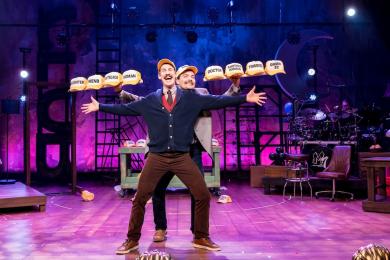
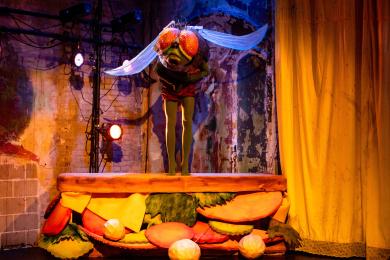
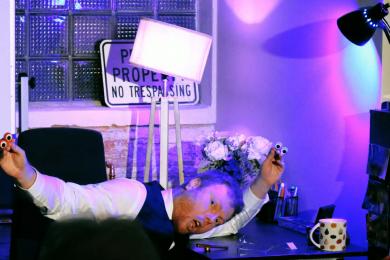
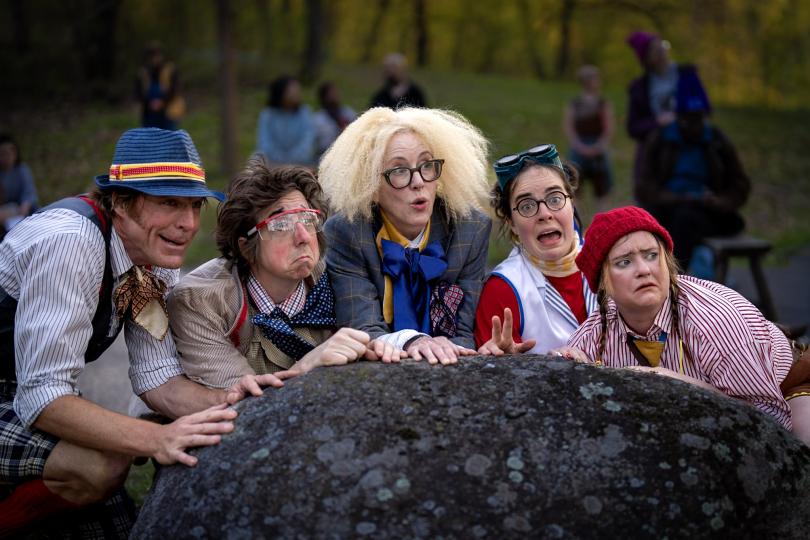
Set at the Theodore Wirth pavilion and additional nearby locations visited promenade-style, audiences experience an exploration of love via clowning performers, acrobats, and musicians. The performance is filled with moments of surprise and delight that I won't spoil here. There's no traditional narrative, and the pre-show announcement noted the workshop nature of this past weekend's performances, suggesting the production will return with more development. Hopefully many times, in the same vein as their production of Nature.
What I'll highlight are the ways Odell's impressions showed up.
When Odell writes about shifting attention from the hijacked attention economy to the local and real, she uses her own awakening to birds as the central story. Doing "nothing" requires a shift, not a removal. I was struck by the level of attention in Big World between the musicians, a partnership with the Brass Messengers, and the performers. What reads at first glance as live musical accompaniment reveals itself, over the course of the piece, as a complete interplay: a single instrument dictating the pace of a moment, musical cues reaching performers hidden from the stage, the troupe following the clowns and mimicking their games aurally. It was a beautiful dance that always felt alive, bounded enough to play within, but never rote. This was attention: a real awareness of the present moment and the environment in which everyone found themselves.
In the latter half of her book Odell expands on bioregionalism, her passion for bird watching having naturally led her to understand the surroundings in which she lived. Big World currently visits two locations beyond the pavilion, and the team did not miss the opportunity to craft our attention in each space. The natural curves of the land, the placement of trees and their overhanging branches, the ways in and out, all of it was considered and used to full effect. Outdoor performance can often mimic indoor staging and miss leveraging its unique location. This was not that case. At one point the five main performers watch from just in front of the audience as a scene plays out high up on the hill. That sense of scale and depth, the reminder that this was only possible here, in this place - made the main performers and us, the audience, one. Perspective shifted, and threads wove between us.
Toward the end of her book, Odell ties together multiple historical references to argue that human interaction is the core of resisting the attention economy. Social media, she contends, is a flattening of narrative - created for everyone, and therefore for no one in particular. Real movements, real change, require in-person presence. And here is Big World's triumph: this is a piece created for the moment of who is experiencing it. Our journey between locations was celebratory as people recognized others they hadn't seen in a while. The production ends with a communal dance. And in the moments of surprise, one of which drew genuine gasps, there is the realization that what you're watching is truly unique because of who you're watching it with. Collectively we experienced something together; a truth that Odell provided to me intellectually over 200 pages, and that Big World helped me share spiritually.
If (when) Big World returns after the TigerLion Arts team develops it further, I can't recommend the experience enough. It is a beautiful celebration from which my attention never wavered.
Main Image Photo credit - Pablo Jones
Left to Right Tyson Forbes, Benjamin Domask-Ruh, Sarah Agnew, Kenzi Allen, Kate Tobie
Note: original text written by Damon Runnals, edited using Claude.ai Sonnet 4.6 model