Interview with John Orenstein




Kit: So, John, this is your second Fringe show. You had a success with Extreme Roadshow in 2023. Can you talk a little about that? And what made you decide to do it again?
John: Extreme Roadshow was based on one type of tried and true framework for musicals: set up a situation where people one by one tell their stories in a series of songs, with a loose plot or through line that ties them together. A Chorus Line, Putnam County Spelling Bee, etc. That made a great start for someone like me who had never written a play before. There wasn't a lot of dialogue.
And it made me want to try to do the same thing again with a theme that I thought might speak to my peer group: retirement, and what it does to one's sense of identity, relevance, purpose. But the play quickly became more generally about a person's search for meaning, because that's what lies behind those other issues - and that's not limited to (pardon me) geezers. Also, we live in a state of outrage and disbelief every day over our government and the state of the world, and that made its way into the show too, because how could it not? I've found that whatever you sit down to write, if you trust your mind and follow the logic of what you're writing, your play and your music will go in directions you didn't expect - but those directions are what you really should be writing about.
And actually, it's more than following logic. There's always a reason behind the words you choose. You may not know what it is, but if you pay attention, something you wrote without thinking about it much may be the germ of a whole element in your play, or a song.
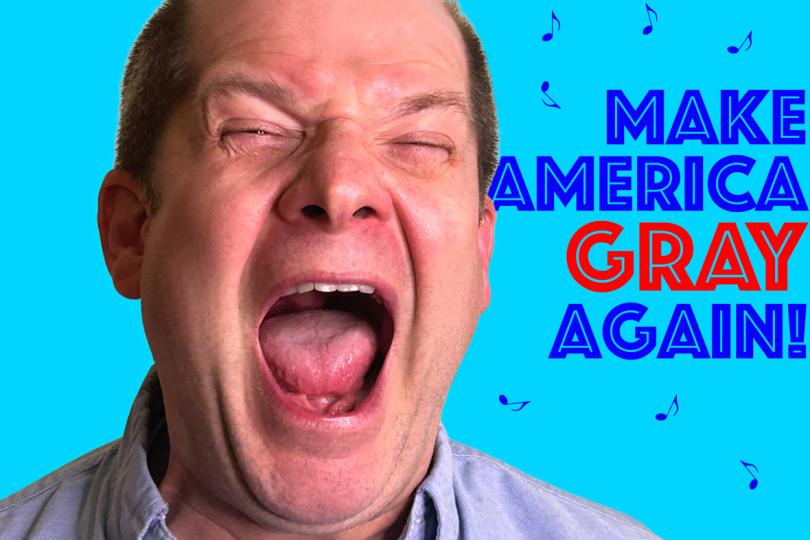
Kit: Now as I understand it, Make America Gray Again - or “MAGA” for short– is a musical/political satire about one man’s involuntary retirement which parodies the self-help industry and touches on the Heritage Society, corporate America, marriage, God, death and the meaning of life, not necessarily in that order. Is that about right? Can you tell us more?
John: The show is satirical, but sometimes it stops to do something else. It seemed to me as I was writing that people might not understand why retirement should be a problem, or worse, might think anyone who was complaining about it was just whining. So the character sings a song ("Who Am I Now?") to try to get the feelings across to the people around him. And then it also seemed to me that if I was going to write about someone's search for meaning, I should have a song that says what the meaning of life is. But since I don't claim to know, I did it from God's point of view, figuring he at least would have an opinion. In other words, the show has satire, but I tried to give it a heart, too. It wasn't worth doing without that.
Kit: Where do politics come in? Do generational issues play a part, what should we make of the titular acronym, and how broad is the commentary? (Don’t say you’ll just have to come and see it to find out – this is an interview.) Or if you prefer, can you just talk a little about the theme or themes of the piece?
John: The first song to emerge in the writing - before the story line was clear - was a baby boomer anthem. It's satirical toward baby boomers, but on the other hand there's a part of the show where younger people are condescending toward them, and it satirizes that too. And in the anthem, that sense of heart is still there, if I did it right (we'll see, won't we?).
By the way, I sound like the show is all me, me, me, but that isn't what the process of doing new work is like at all. The director, the choreographer, and the performers turn a script and a score into a show. As they do that, they put their own stamps on it. I learned from Extreme Roadshow that what you're doing when you write a musical is creating a platform for other artists. If you find that exciting, it's wonderful. If you don't, maybe you should keep writing songs that you just sing yourself.
Kit: What prompted you, John Orenstein, to write a show about retirement? Can you talk a bit about the evolution of the show -from idea to book to Fringe?
John: I was very active in the Senior Lawyers and Judges Section of the bar association for four years. Our most successful continuing legal education programs were always about retirement - programs with titles like, "Who Am I Now that I'm No Longer Doing What I Was Doing?" It was natural to start there. I had a secret ambition to market the show to groups with an interest in such things to put on themselves, but in the writing, the show quickly disqualified itself from that. The only things that survived from that non-artistically-motivated concept were the talking book ("Retire Like You Mean It") and the song where our hero takes up running ("Born to Jog"). Otherwise the idea required the show to be, well, boring.
Kit: You yourself are a recently retired lawyer, John, are you not? Aside from writing Fringe shows, how have YOU been spending your retirement? How is it going?
John: I've been retired over two years. I approached retirement by saying yes to everything: political activism, the bar association stuff, music opportunities (I'm the choir director at a synagogue now, for example, and I'd never directed a choir before in my life). I guess I've gone from being a lawyer who struggled with work/life balance to being a retiree struggling with unpaid work/life balance. I haven't found equilibrium yet, but I'm working on it.
Kit: Let’s talk a little about your musical background? You majored in music in college. Did music play a role in your upbringing? Who were your favorite artists growing up and what music has been influential? How do you stay involved in creating and/or performing music, aside from Fringe?
John: I went to Oberlin. I was one of two piano majors I knew who wanted to be Elton John. (In my defense, it was the '70s.) I think we both went to law school.
My brother and sister and I were all interested in music and theater, and my parents were great supporters of that. They had all those classic '50s and early '60s Broadway cast albums, and my dad had Louis Armstrong Hot Seven records. And they let us spend our allowance money on whatever records we wanted. So we all heard a lot of music and took music seriously, as kids in those days sort of ridiculously did (Crosby Stills Nash and Young! Joni Mitchell! Paul Simon! Randy Newman!).
A great gift for me was my piano teacher's love for 20th century music. In fourth grade, I had to audition to study with him. He asked me to sightread a page of Prokofiev, which I did my best to do. Then he turned the book upside down and asked me to sightread it now. So I did it as if the upside down version was the way the notes were actually written. In that one little act he showed me that anything in music is possible. Also that Prokofiev right-side up and upside down don't sound all that different from each other.
Kit: It happens that you’ve got one of my dear friends and favorite local actors, Sue Gerver, in your cast. (She’s got comic chops so I can’t wait to see her.) Some of the other cast members and artistic team you’ve worked with before, is that right? Can you talk about the company and what working together on this show has been like ?
John: Everyone in the show gave a terrific audition. But as we got into rehearsals, we learned more clearly what they were particularly strong at as actors, and Barbara Wiener, our director, led them in the direction that played to their strengths. It's especially fascinating to watch Eric Lee - who plays the main character and was in Extreme Roadshow as our politically deranged baseball card collector - evolve his performance from rehearsal to rehearsal. He probably isn't thrilled that we have him fall face down on the floor in two different scenes.
Kit: Assuming the show is a roaring success, which all reasonable, intelligent people fully expect it to be, do you think you might develop MAGA further into a full-length piece? Or will you go on to write a new show? What can we expect to see from John Orenstein, writer and composer, in the future?
John: Honestly, one fun part of Extreme Roadshow was that there was a part for Debbie in it. I couldn't figure out how to do that this time. I think the next thing we do in the Fringe might be a straight-up song review where she and I perform new material, because as much as I've gained by writing in the musical comedy medium, Debbie and I really like performing together. And when we write together, she supplies actual punch lines, which are hard for me.
Kit: When you go to the Fringe opening night party, what will you be singing assuming there is karaoke? I don’t know what bar they hold the Fringe parties at these days. They used to have karaoke.
John: OK, I'm skipping this one.
Kit: Lastly, tell me what you love about the Minnesota Fringe Festival. Why should taxpayers and private donors continue to support it?
John: The Fringe Festival plays an absolutely critical role in the arts in the Twin Cities. Without it, putting on theatre is just a distant dream for most people, no matter how creative they are, no matter how much they have to say: because in today's environment, the barriers to entry for new theatrical work are impossibly high. You need tons of money, you need a marketing apparatus ... the Fringe makes it possible to create a show without depleting your life savings, to collaborate with talented, adventurous artists, and to get in front of an audience. Even if you don't go to a Fringe show, it nurtures the arts here - and without relying on federal funding (so it can't get the plug pulled on it that way). We'd be a much, much poorer community without the Fringe Festival.
“Make America Gray Again!” performs at the Phoenix Theater in Minneapolis as part of the Minnesota Fringe Festival. For performance dates, tickets and more information, go to.
https://minnesotafringe.org/shows/2025/make-america-gray-again