The road to Ricky with RASHAD FRETT, filmmaker

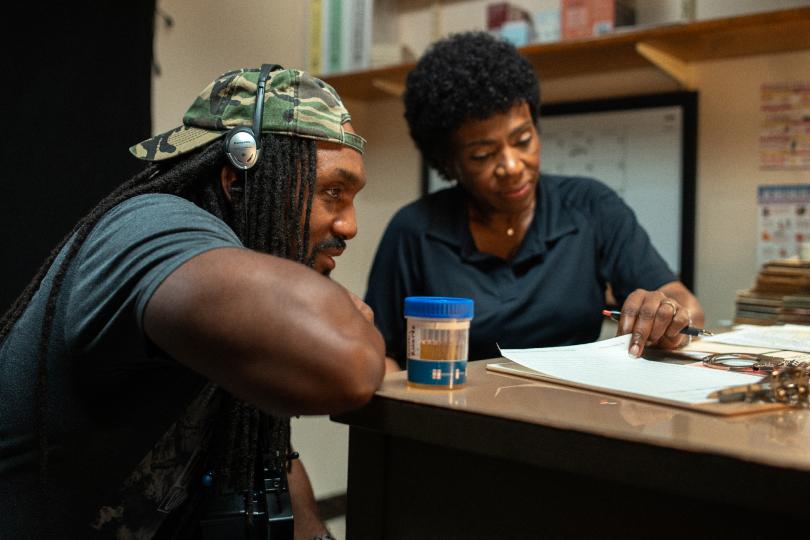




From the beginning of Ricky, Rashad Frett’s debut feature film, which recently won the US Dramatic Directing Award at the 2025 Sundance Film Festival, we are dropped into a gripping world we may not trust, because the narrative comforts we’ve been programmed to depend on are relatively rocky: protagonist and antagonist, the textbook love interest, etc. I spent the first act trying to decide which relationship to invest in. And it’s because we, the audience, are looking keenly through the adolescent lens of the titular character Ricky, a 30 year old man who has returned home from a fifteen year prison stint. (You do the math.) He doesn’t trust the modern world he is reentering, and so we, the audience, are navigating his new world with his suspicion. We don’t know who to trust, and neither does he.
The social network Ricky has to navigate when he is released from prison is just as complicated as the criminal justice system that imprisoned him for fifteen years. He is a relatively free person. (He still has to check in with an acerbic parole officer - played by Sheryl Lee Ralph.) But freedom means he has a million choices. Many of which can send him back to prison. We go to the theater to watch characters make decisions. Our theatergoing experience is only heightened when it is clear to us that each decision a character makes has the power to redetermine their fate. It doesn’t take long for us to understand that Ricky is expected to make adult decisions with the psychology of a teenager. And, without preaching to us, the film shows us the incapability of a correctional institution to prepare a recently incarcerated person to reenter society without adequate mental health services.
Frett, the film’s director, has a background in directing documentaries on the criminal justice system back in his hometown of Hartford, Connecticut, and his father was a correctional officer. His MOS (a short silent film called Homecoming) in film school also explored the theme of recidivism. He cares about the subject in the film, and the verisimilitude of each character. In essence, Ricky is a singular portrait of community and Black manhood in America, and it takes a closer look at someone we walk by on the street everyday.
Rashad and I talked about his creative process after a private screening of his film at NYU. In the interview we discuss the road to Ricky, collaboration, and telling stories audiences can connect with.
TS In your debut feature film Ricky, the titular character is quite compelling? Is he based off of someone you know?
RF No, the protagonist isn’t based on one person in particular. I often pull from people around me. He’s a fictional character based off of numerous peers that I know from my hometown.
TS What determines your interest as a filmmaker?
RF The power of media and how it affects the masses interests me as a filmmaker. Being able to write a story that an audience can connect with and can learn from is what drives me as a filmmaker.
TS What are three things you cannot create without? And why?
RF I cannot create without my life experiences that I pull from when making a story, a quiet space to ponder on ideas, and great collaborators to brainstorm and create with.
TS Walk me through your creative process? How do you create? Can you identify a routine?
RF I hit the gym first. Then I go to my quiet place afterwards and start to write. In this process, I need a bag of raw cashews and water and I’m good to go for hours lol!
TS For whom do you create?
RF I create for the masses and also myself. In my work, I always have a message for people to learn from and some projects are often therapeutic for me.
TS When do you know it’s time to abandon a project?
RF In regards to developing a project, if it’s one that I’m passionate about, but I may be stuck on what direction I want to go with it story wise, I’ll take some time away from it, and then come back with fresh eyes. That normally helps me to continue with it rather than deciding to abandon it entirely.
TS When did you know you wanted to make films?
RF When I was in undergrad, I initially pursued theater, but after taking my first filmmaking class, I was hooked, and I made the shift from wanting to be in the front of the lens to behind it.
TS At what stage in your creative process do you invite collaborators?
RF From the very beginning. Collaboration is very important to me. It’s a huge part of my success. Not only for my projects, but for my collaborator’s films also. Building a solid team is key.
TS How important is it for you to finish a project from start to finish?
RF Completing a project not only brings a sense of closure and accomplishment, but it also allows me to fully realize the original vision and reflect on the process. Finishing is where growth happens—both creatively and professionally.
TS What obstacles did you face developing Ricky? Personal or professional.
RF Initially it was financing and also finding the right people to bring on my team that fully respected and supported my vision in its entirety.
TS What advice would you give to young filmmakers?
RF Never ever give up. Even if people don’t believe in your goals. It may take longer than expected, but it’s all good. It’ll happen when it’s supposed to, if you stay the course. Also, put out positive energy and it’ll come back to you in many ways; and keep negative energies out of your circle. These are some of life’s codes that have worked for me numerous times.
TS What role does faith play in your creative journey?
RF It plays a huge factor as I’ve seen firsthand how great things happened for me by keeping the faith, whatever your faith may be, and trusting its guidance in executing your goals.
TS Name one film you can’t go a year without rewatching? And why?
RF I can’t go a year without watching my short film K.I.N.G. as it is an extremely personal film about my life and has therapeutic factors for me that I aim to expand into a feature one day.
TS What projects are you currently working on, and where can our readers follow you and find out more about your work?
RF We’re currently aiming to get our feature film RICKY a theatrical release sometime soon. So please keep looking out for that, and spread the word. I’m also developing some more spinoff films that tie into the RICKY universe, and I’m developing a crime thriller that I’m excited about!
You can follow me on instagram at Cinerebel860 - and checkout my website https://www.rashadfrett.com/ to stay updated on my projects.
Rashad Frett is an Award-Winning Caribbean-American Filmmaker. He earned his MFA from NYU Tisch Graduate Film. He is a Spike Lee Production Fellow, a Ryan Murphy’s HALF Initiative Fellow, a Cary Fukunga Production Grant Recipient, a Sundance Feature Film Production Lab Fellow, and one of Filmmaker Magazine’s “25 New Faces of Independent Film.” Frett’s debut feature film “RICKY” won the Directing Award in the 2025 Sundance film festival’s Dramatic competition category. He is represented by WME.
Starring in Ricky: Stephan James, Sean Nelson, Maliq Johnson, Simbi Khali, Sheryl Lee Ralph, and Karen Chilton