Keep Your Eyes on Vanessa Brooke Agnes




My first encounter with Vanessa Brook Agnes’ work was fortuitous.
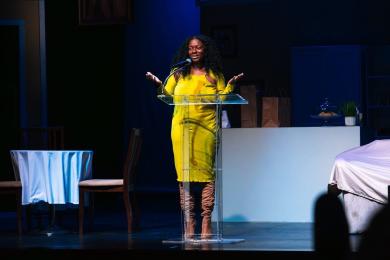
I went to see On Freeing Fire - a one-woman show written and performed by Zola Dee at Red Eye Theater, and I remember being deeply moved by how grounded and sparse the production was. It was rooted in oral history and the familiar love of family. Zola Dee’s family. In fact, it was about her late aunt. One may even describe it as a tribute-play. Which is what happens when biography falls into the hands and hearts of theater makers. This is how we get American Classics like Tennessee Williams’ Glass Menagerie - which tributes Williams’ sister who became his dependent after suffering a lobotomy in 1943; Or Lorraine Hansberry’s magnum opus A Raisin in the Sun - which is drawn from the violence her family encountered while integrating a Chicago neighborhood with staunch racial covenants - ultimately leading to the 1940 decision Hansberry v Lee - involving Hansberry’s father. We get these plays because a playwright loved someone enough to write about them and concretize their existence in words so that they will always be remembered. These are blood-plays. Blood-plays are stories that have roots in blood memory and provide windows into history. But a playwright does not make plays alone. They are paired with a collaborator - who interprets and stages the story. That’s where the work of Brooke Agnes begins. She is a performer and director who also works in arts administration. And her many hats inform her keen eye. I’ve recently had the opportunity to watch her work on a new play at History Theatre in St. Paul. She has a graceful interpretive hand - kneading the story into fruition like a potter shaping a ball of clay. From scene to scene the clay changes its shape, and it owes a debt to her direction.
Interpretation is a selfless art. Like writing, one has to find their way in - in order to tell a moving story. In order to tell a moving story, the storytellers must themselves be moved. Directors are as much storytellers as any writer. Booked and busy, Vanessa took a moment to chat with me. In our interview we discuss her deep roots in the theater, the theatrical vein in her maternal line, laughter, and the stories she wants to tell.
TS How did you get your start in the theater?
VBA My mother was in a traveling acting troupe in her youth and has always loved going to see live theater. I remember my very first experience as a narrator for our Kindergarten class production of How the Grinch Stole Christmas. In my youth, I performed in theater camps and was an early leader serving as an assistant director in middle school. Throughout high school and college I was heavily involved in community theater, and I got my start directing in my classes at the University of Wisconsin-River Falls, during our student-run productions. Upon graduation, I began co-directing and directing youth shows and growing my teaching artistry. After working in theater education at various arts organizations, I continued to direct for theater institutions across the Twin Cities, and in 2020 I founded a new arts collective, Dark Muse Healing Arts.
“I felt called to create space”
TS I’ve watched you lead a room of actors. And it makes so much sense that your first role in the theater was as the narrator! There is a calmness about your leadership that is also present in effective narration. What prompted you to start Dark Muse Healing Arts?
VBA Amidst the uprising in the summer of 2020, following the murder of George Floyd, I felt called to create space for Black, brown, queer and trans folx to experience communal healing through creative expression. I organized our first event, a protest + performance to invite joy and connection, even/especially in times of collective grief. Since our inception, we have curated radical care experiences that bring art and healing together through restorative community spaces and arts experiences. Recent events include Drag Tea: a free high tea party and drag show, and SOUL CARE: a pop-up art activation with live performances, storytelling and art-making.
TS Can you identify any transferable skills between arts administration and directing?
VBA Absolutely, half of the job is creative in nature and the other half is administrative by way of necessity. As a director, you aren’t just in the room staging and working with actors, you’re part of the process from the jump - with the producers and staff of an institution, meeting individually and collectively with designers and others on the production team, you’re fielding emails and questions from every direction, the calm eye at the center of a beautifully orchestrated storm. I am grateful for my admin career experiences - as they’ve made me a more organized and thoughtful director.
TS What sort of stories are you interested in telling?
VBA I tell stories that reflect our lived experiences and stories that imagine new worlds and infinite possibilities. In my own writing practice, I explore afrofuturism, immersive sensory storytelling and infusing spirituality into my creativity. I love stories that balance humor and heart. Through the stories I tell, I hope to make people feel seen and held.
TS How do you prepare to direct a new play?
VBA I read the script many times. The first read I take note of lines or themes that jump off the page at me, and I take those ideas and use them as inspiration for my initial vision and concept for the show. As I read the material more and get intimately familiar with the flow and vibe, it helps me understand what kind of story we are telling, allowing me to guide others on the journey. I enjoy a healthy amount of table work in preparation for working with new text, gathering thoughts and feedback from the actors in the room and bouncing ideas collaboratively with the playwright. I love to know why the writer chose to tell this particular story and let that “why” guide us.
“my job is to care for my people in the room”
TS As a director, how would you describe a successful rehearsal room?
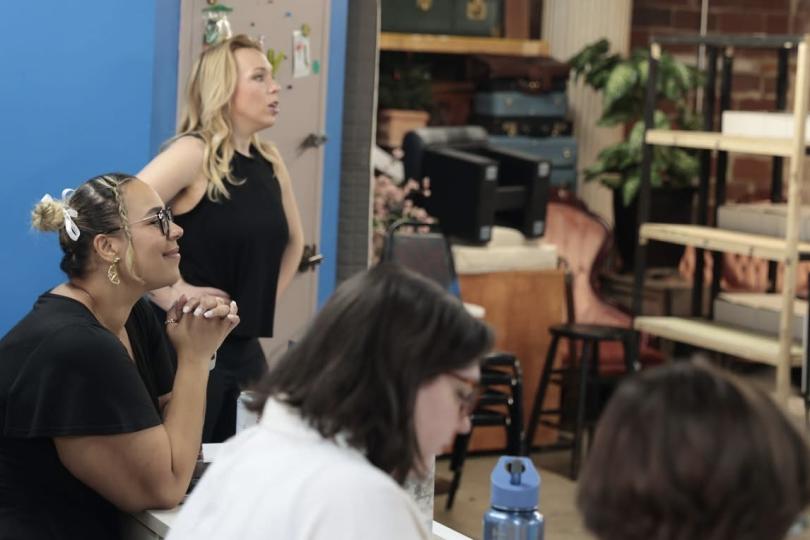
VBA A successful rehearsal room is one where everyone feels empowered and safe enough to do their best work and explore the most honest storytelling they can. To have positive and professional relationships with the people around you makes working together so much sweeter and I always say my job is to care for my people in the room - I take that job seriously. I fiercely value the process and believe the first priority is prioritizing our humanity during the intensive process of mounting a production. The room is well and successful when people are treated as fully dimensional humans, not machines, and their collaboration is respected and welcome. Especially when you have hard workers and lovely people like we currently do in the company of Don’t miss Doris Hines. We get to have a lot of fun together!
TS How do you want audiences to experience your work?
VBA I want my work to make audiences think, to move them and have an experience of empathy. To feel what it might be like to step into someone else’s story and gain a new perspective. I want my work to open minds and hearts.
TS What role does faith play in your creative journey?
VBA Much of my creative journey has been intertwined with my spiritual journey. My ancestors have prepared me to be in every room I step into - which is what I remind myself of whenever I feel any sort of impostor syndrome. I know that any aligned opportunities that come my way are for me, and I’m meant to be in these spaces I’ve worked hard in my career to inhabit. It sounds so cliche but it’s true that you have to believe in yourself and your creative power first.
TS Name one song you can’t go a year without listening to?
VBA Greatest Love of All by Whitney Houston because the children are indeed our future and learning to love yourself is indeed the greatest love of all.
TS Yes, those lyrics are so matter-of-fact. When was the last time you laughed hysterically?
VBA Honestly, it has probably been in the rehearsal room with the cast of Don’t miss Doris Hines! Every single one of the actors in our company is hilarious, and we’ve had so much fun with each other. They make me laugh hard every day.
TS What projects are you currently working on and where can our readers follow your work?
VBA I just directed Don’t miss Doris Hines at the History Theatre, coming up next I am directing How to Catch Creation at Theatre in the Round and assistant directing A Christmas Carol at the Guthrie. I’m finishing the first draft of my own full length play, and I’m producing ongoing events through Dark Muse Healing Arts. You can stay tuned at darkmusearts.org and @darkmusearts or @vanessabrookeagnes on instagram.
Don’t miss Doris Hines runs at History Theatre from Sept. 18 - Oct. 12
Vanessa Brooke Agnes is a director, writer and founder of Dark Muse Healing Arts. She has worked with respected institutions such as the Guthrie, Hennepin Arts, History Theater, Playwrights Center, Artistry, Lyric Arts, Walker Art Center, among others. After graduating with honors from the University of Wisconsin-River Falls with dual degrees in Theater Arts and Communication Studies, she founded a grassroots community organization in 2020, whose mission is to center Black, Brown, Queer and Trans healing through creative expression. She lives in South Minneapolis with her pup, Winnie.