The Bones of Making Art with Martryce Roach

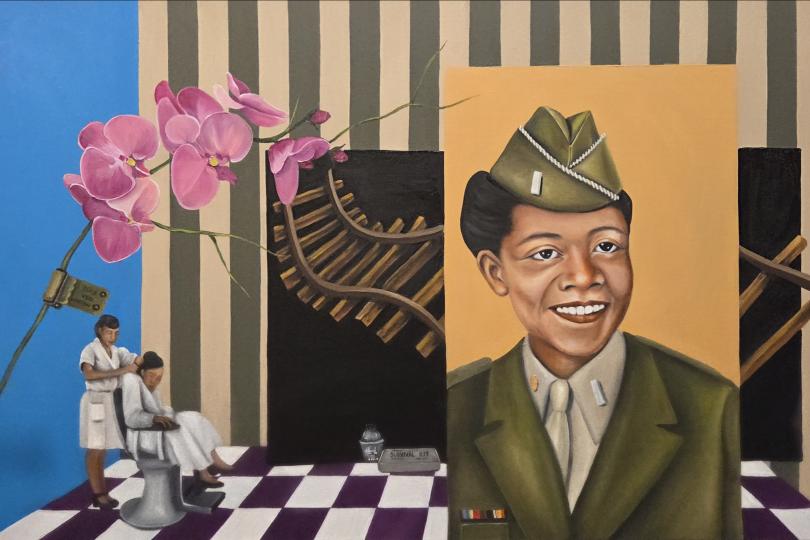




Heading Image: "I don't look like what I've been through"
She was introduced to me as an artist to watch at a gallery opening way downtown in Newark, New Jersey. The room was full of some of the city’s most prolific young artists including muralist Malcolm A. Rolling. Many of whom had come together to share and celebrate new work. Her work was not so much on display that evening, but in a brief, but detailed, introduction - sans the networking formalities - I managed to walk away from our small talk with a description of her aesthetic and a business card with a link to her website which features a selected gallery of her artwork. I immediately skimmed through her latest works on my phone - which included limited edition prints - some of which had been sold out or were selling out fastly, and it was apparent why: her gaze is as nuanced and culturally specific as it is limitless. The soft but brilliant color palette in a Martryce Roach piece compliments a minimalist or maximalist approach to decorating or anything in between. Her artwork would look great on the wall of a bustling hair salon and hanging quietly in your foyer, because it’s elegant and grounded. And the groundedness of Roach’s surehand sets a welcoming mood for any atmosphere. In our interview we discuss her familial roots in music, subconscious art making, and her anticipated new body of work: a series centering a diversity of subjects as giants who transcend the limitations placed on them by society. She describes herself as a visual-storyteller who resonates with the shifts in an arresting John Coltrane ballad. All of which she single-handedly captures one painting at a time.
TS Art has the ability to reflect certain themes born out of the time in which it was created. What does your art reflect?
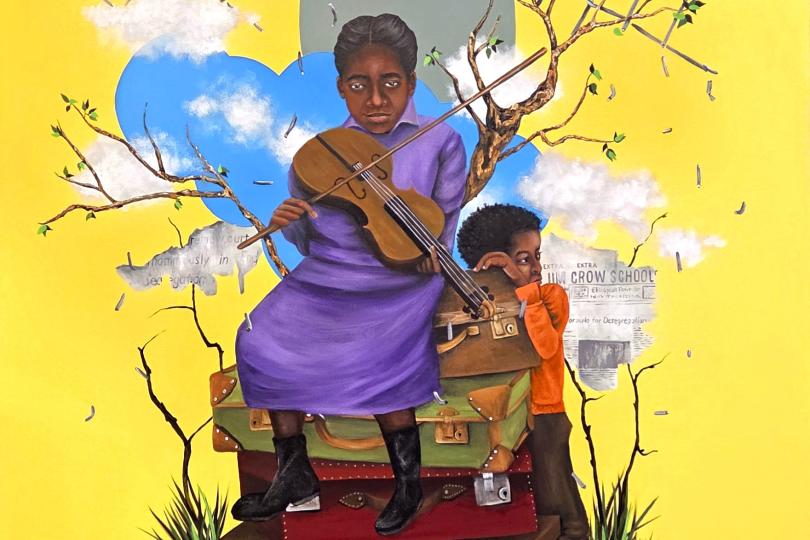
MR My work often explores the times and experiences that shape American culture, particularly through the confrontation of oppression, the evolution of civil rights, and rejuvenation found in new hope. I like to create stories that preserve memories and illuminate the collective impact of history - while also acknowledging parallels between systemic challenges in the past and those that we face today. I would say my work is a reflection of both then and now. It celebrates endurance, resilience, and creativity evident throughout the journey of African American people over time.
TS How would you describe your creative discipline?
MR I describe myself as a visual storyteller. My discipline is a combination of folk art, which preserves history and culture and visual art, which means that my work is experienced by sight. I create vibrant landscapes, layering elements of the environment with figures to explore the intersection between space and human behavior.
TS Where does your inspiration come from?
MR I find inspiration in experiences. To me, life is filled with twists, blocks, turns and waves. How we all swerve through those changes tells a powerful story and makes for a magical visual. Working with cultural experiences as source material, my practice serves as a reflection, connecting viewers with shared narratives and feelings.
TS Are you a first generation career creative?
MR Not at all. My father is a musician, a guitarist. Lots of people in my family have creative passions. My first introduction to the arts was definitely music, and it shows. My work, though visual, moves like sound.. Looking at it, some would say it is like visual jazz.
TS What are three things you can’t make art without? And why?
MR I am art; I’m always making art. Even when I am not physically creating, my mind is working. I don’t think it is something that gets turned off. It's intrinsic. There are some things that help my ideas flow, though, for sure. Top three would be music, good lighting, and an important story that I can feel deeply as a foundation for the work I am creating.
“... I am very intentional about the bones of my pieces.”
TS Yes, I always encourage playwriting students to pay attention to the gestation stage - the subconscious process of making art. Walk me through your creative process? How do you create? Can you identify a routine?
MR My art is rooted in heritage and humanity. So, my process starts with social work. I am usually touched by a social challenge, a community need, a principle of social justice, a need to educate or advocate, something like that. I research heavily and immerse myself with images and information related to the topic I am exploring. Then I try to develop a blueprint for the layout of my work. Strong messages can be delivered in the placement of images, the color psychology, the satire of surrealism. So I am very intentional about the bones of my pieces.
TS For whom do you create?
MR This question convicts me. I can honestly say that right now, today, I strive to create work that I feel is important – work that will inspire social change. It wasn’t always that way though. If I can be truly honest, I had gotten to a point in my career where I wanted so desperately to feel financially successful and supported by my gift that I began to create work I thought people would want to buy, taking on commissions and working just to get paid. I was abandoning my purpose, and it took all the joy and fulfillment out of creating for me.
TS Thank you for being so transparent, Martryce. I think that’s a conviction so many creatives could relate to. At what stage in your creative process do you invite collaborators?
MR In the last few years or so, I have stepped into a new lane of creative entrepreneurship. Combining my lifelong passion for the arts with my twenty-year career in social work, I have been delivering powerful social messages through massive art created for public spaces. This has included murals and digital licensing. The new process has required that I collaborate with other artists and teams; and doing so has elevated my practice monumentally.
TS How important is it for you to finish a project from start to finish?
MR I like to finish what I start, and I do that most of the time. There are some unfinished projects I have laying around though. Sometimes life gets in the way, and I have to put a work-in-progress to the side. When I come back to it, I am just not always in the same mental and emotional space I was in when I started.
TS What creative obstacles do you face? Personal or professional.
MR Space. I definitely need more space. I am also a freelance, sole proprietor, working without gallery or agent representation. That means, I create the art, seek out the opportunities myself, negotiate the contracts, keep the books, process the taxes and accounting, network, process sales, handle shipping, handle marketing and PR, manage social media, manage public art teams, etc. Having to do everything myself takes away from the time and energy I could have to create.
“Rest, but don’t quit.”
TS What tips do you have for creatives who may be facing their own challenges?
MR Rest, but don’t quit.
TS What role does faith play in your creative journey?
MR As an artist, everything is done in faith. You never know how or if the works you create will be received, but you create anyway. Validation cannot be the driving force. Faith is. Art, to me, feels purposeful. It is what I was created to do. So I have to believe that my gift will make room for me - that if I am obedient to the will of God, I will continue to be blessed.
TS Name one song you can’t go a year without listening to? And why?
MR “In a Sentimental Mood” – Duke Ellington and John Coltrane. Firstly, I really appreciate art that requires no words – something you can just feel. This wordless ballad starts off slow and dreamy and shifts to become more upbeat. I resonate with the changes, with the uncertainty in it about life and love. It stops me in my tracks whenever I hear it. I admire its arresting quality.
TS When was the last time you laughed hysterically?
MR My girl and I recently tried an activity where we made up a story by offering one word at a time alternatively. The result was hilarious!
TS Name one thing you’re absolutely over? How did you get over it?
MR I am a recovering undercover over-lover. Sometimes, we encounter situations that are designed just for us to be a blessing to others. It’s not always about us. Some things are much bigger and more important than personal gain. With that being said, I am absolutely over - over-loving. I can’t pour from an empty cup. I usually try my best to show up, at times at the expense of my own health and well-being. I’ve decided to set clear, firm, boundaries to ensure that, while I strive to live this purpose driven life, I am not abandoning my own self and that I am well.
TS What projects are you currently working on and where can our readers follow and find your work?
MR Right now, I am working on a new body of oil paintings on canvas called “Bigger.” The collection presents children as giants who transcend limitations placed on them by systems like poverty and societal norms. Follow me at www.martryceroach.com for my latest news and exhibitions.
Tylie’s art recommendation: I can’t stop thinking about Martryce Roach’s limited edition print (“Library Series I”) where a studious woman with an abundant headful of locks is buried in a book at the bottom of a tall and colorful bookshelf. It reminds me of the nights I spent in the siloed aisles of campus libraries searching for the perfect handful of books. Fun fact: each print comes with an autographed Certificate of Authenticity. Check it out!
Artist Biography
Raised in New Brunswick, NJ, Martryce Roach is a self-taught artist whose style is marked by her mix of history, musical references, figures, and geometric shapes in the construction of surrealistic stories about human experiences and relationships particularly as they relate to African American culture. Roach has a Bachelor’s Degree in Public Health and Africana Studies and a Master’s Degree in Social Work. The context for Roach’s work stems from her passion for humanitarianism. Several of Roach’s works, including oil paintings and pastel on paper, have been acquired into permanent museum collections and remain on view as permanent public art installations.
Carousel images:
1. 'Roots, Watered Children'
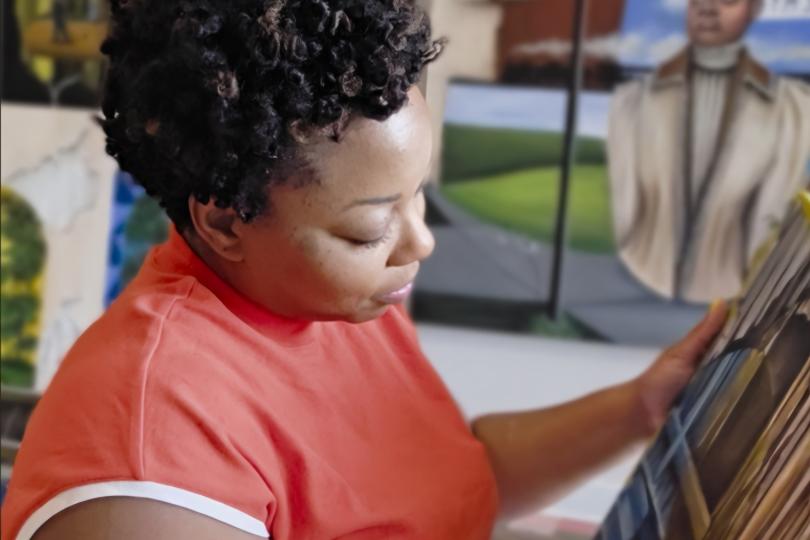
2. Artist Martryce Roach